OffsetCrust: Variable-Radius Offset Approximation with Power Diagrams

Zihan Zhao1,Pengfei Wang1,Minfeng Xu2,Shuangmin Chen3,Shiqing Xin1,Changhe Tu1,Wenping Wang4
1Shandong University,2Shandong University of Finance and Economics,3Qingdao University of Science and Technology,4Texas A&M University
arXiv preprint, 2025
Corresponding Author

By assigning varying offset distances (visualized using different colors) to the vertices of the input Centaur model, our method generates a set of outward variable-radius offset surfaces: (a) the front part is enlarged significantly more than the rear, (b) the rear part is enlarged significantly more than the front, and (c) a export constant-radius offset is applied uniformly across the model.

Abstract

Offset surfaces, defined as the Minkowski sum of a base surface and a rolling ball, play a crucial role in geometry processing, with applications ranging from coverage motion planning to brush modeling. While considerable progress has been made in computing constant-radius offset surfaces, computing variable-radius offset surfaces remains a challenging problem. In this paper, we present OffsetCrust, a novel framework that efficiently addresses the variable-radius offsetting problem by computing a power diagram. Let R\mathcal{R} denote the radius function defined on the base surface S\mathcal{S}. The power diagram is constructed from contributing sites, consisting of carefully sampled base points on S\mathcal{S} and their corresponding off-surface points, displaced along R\mathcal{R}-dependent directions. In the constant-radius case only, these displacement directions align exactly with the surface normals of S\mathcal{S}. Moreover, our method mitigates the misalignment issues commonly seen in crust-based approaches through a lightweight fine-tuning procedure. We validate the accuracy and efficiency of OffsetCrust through extensive experiments, and demonstrate its practical utility in applications such as reconstructing original boundary surfaces from medial axis transform (MAT) representations.

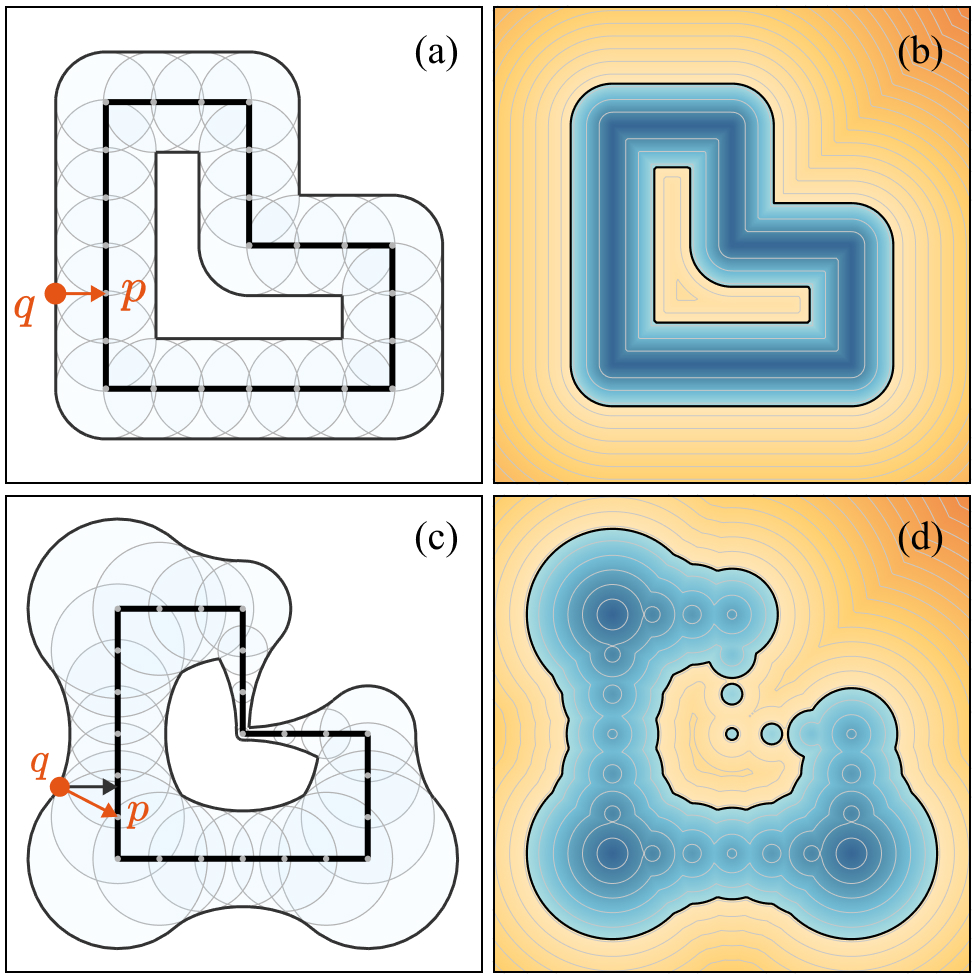
Intro: What is Variable-Radius Offsets?
Results: Variable-Radius Offsets
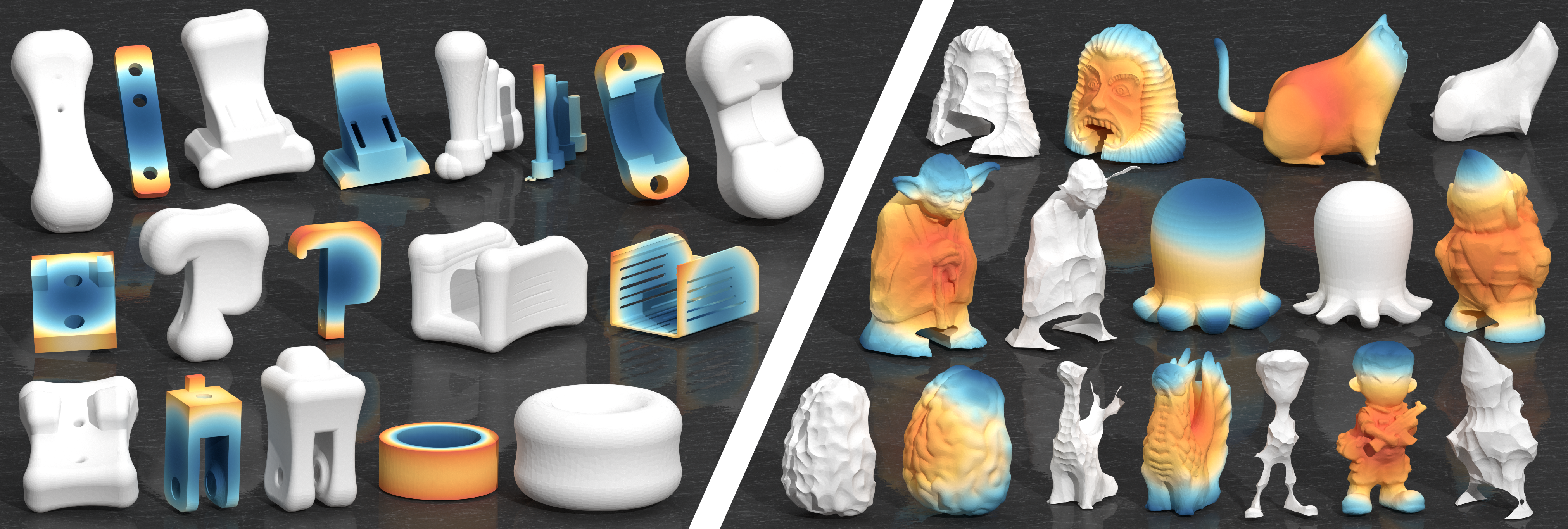
The distance field indicates offset radii, and the white models are the outputs. Left: CAD models from the ABC dataset and their outward offsets. Right: Freeform models from Thingi10K and their inward offsets.
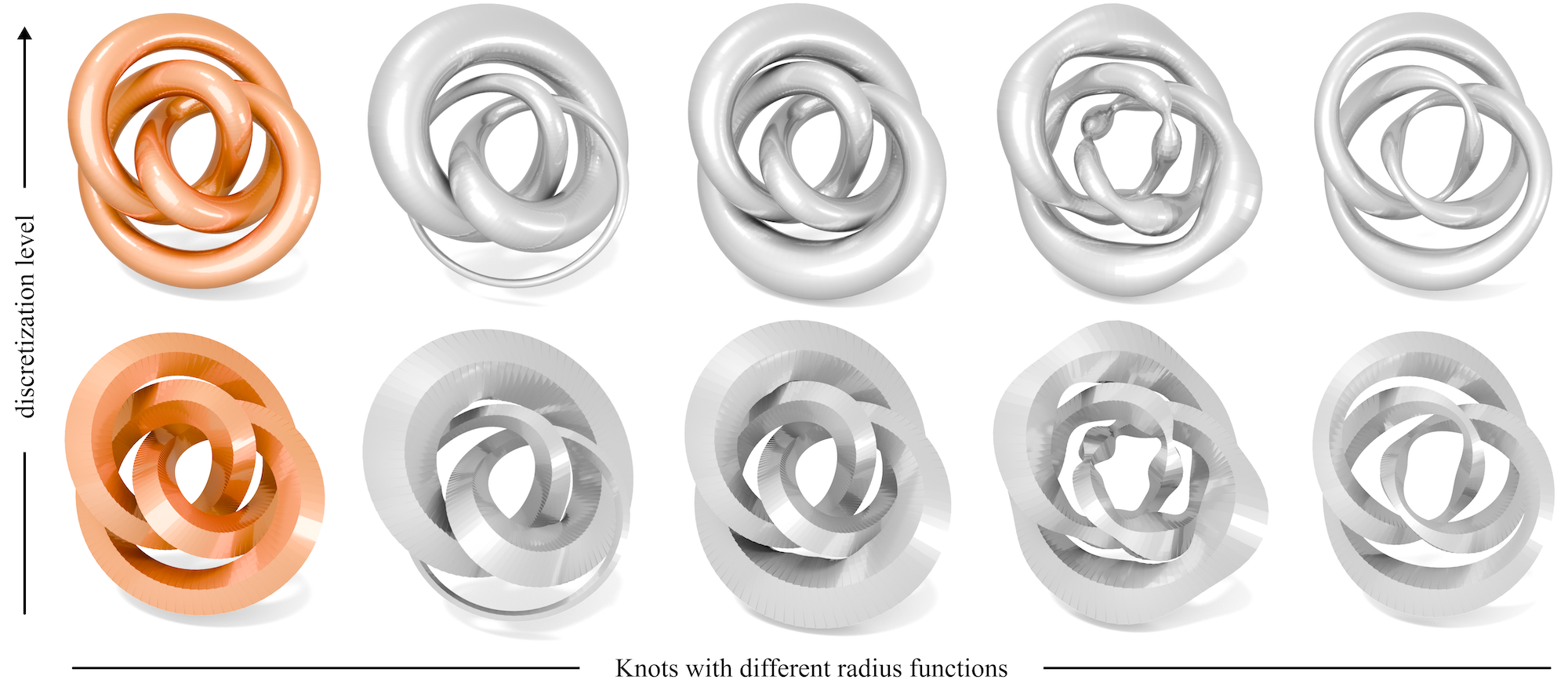
Offset-Based Channel Surface Modeling: By applying different radius function along the directrix of knot model, our method generates diverse channel surfaces.
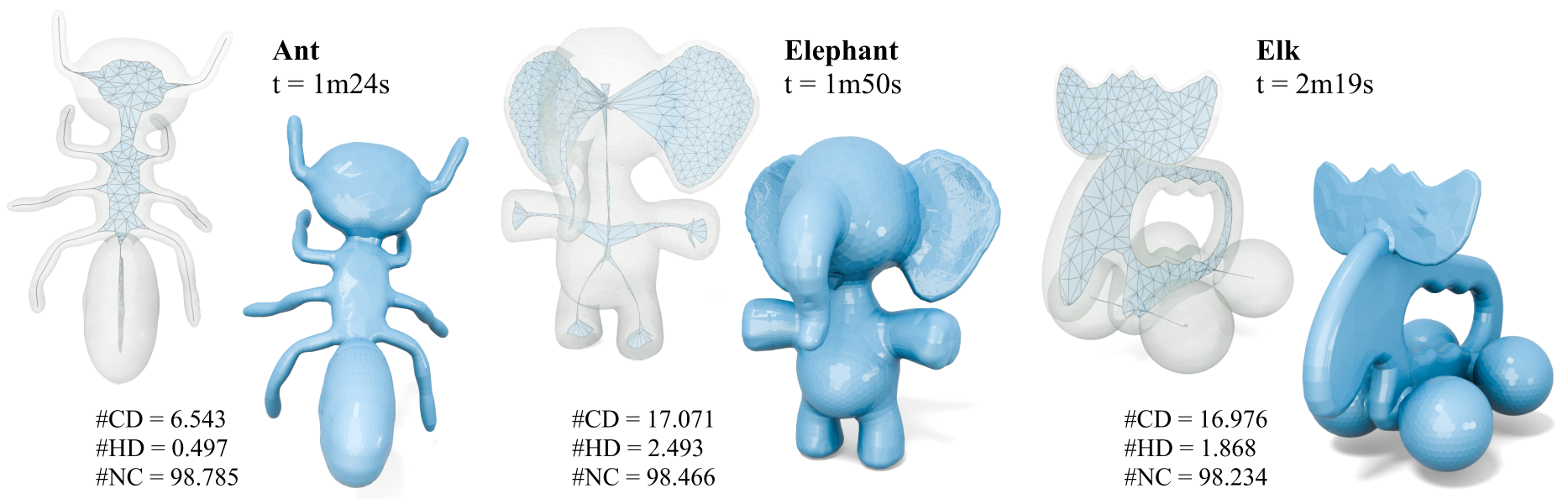
Surface reconstruction from medial axis transforms (MATs) generated using variable-radius offsets computed by our method.
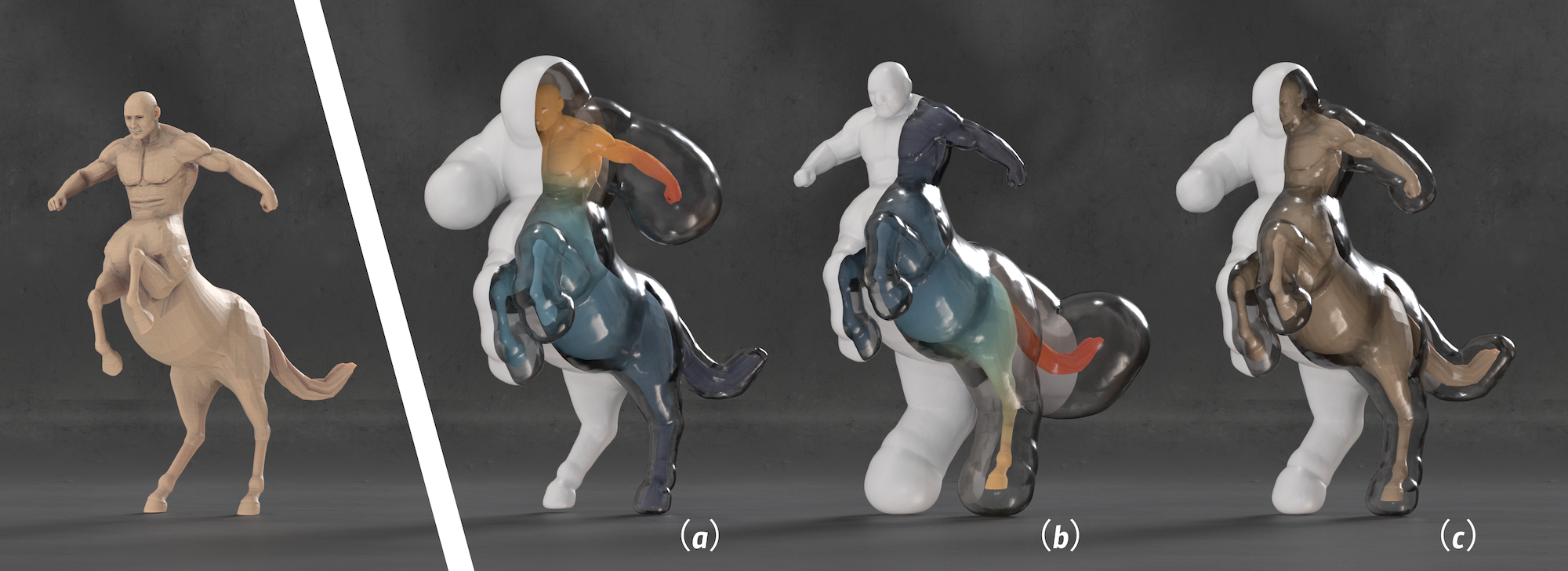
Surface design by varying offset distances at different regions of the Centaur model.

Results: Constant-Radius Offsets
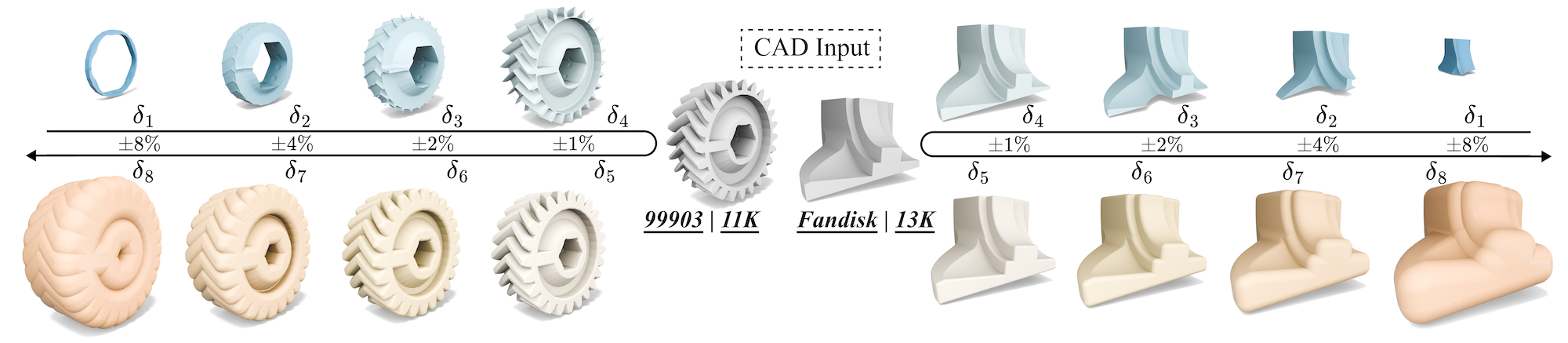
Qualitative results of the constant-radius offset of CAD models at various offset distances. The behaviors of sharp features in the offset are handled correctly, preserving sharpness in the inward offsets and roundness in the outward offsets
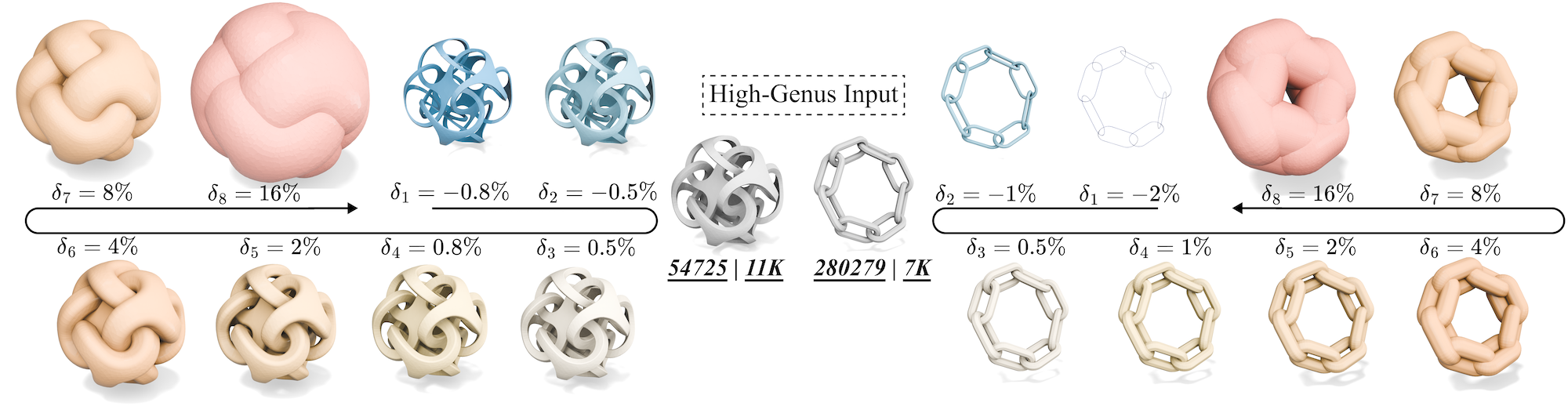
Qualitative results of the constant-radius offset of high-genus models at various offset distances. Topology changes are preserved correctly, increasing or maintaining the genus in inward offsets and reducing or maintaining it in outward offsets.
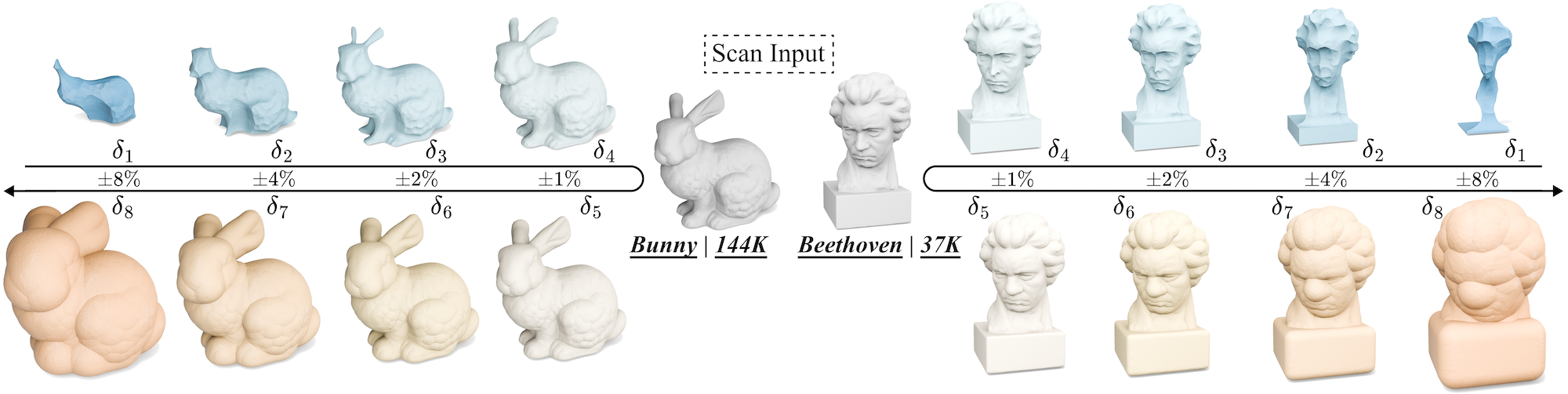
Qualitative results of the constant-radius offset of real scan models at various offset distances. The details are captured and processed correctly, and the features appearing in the offset surfaces are well preserved.

BibTeX

@article{zhao2025offsetcrust,
  title={OffsetCrust: Variable-Radius Offset Approximation with Power Diagrams},
  author={Zhao, Zihan and Wang, Pengfei and Xu, Minfeng and Chen, Shuangmin and Xin, Shiqing and Tu, Changhe and Wang, Wenping},
  journal={arXiv preprint arXiv:2507.10924},
  year={2025}
}